Portuguese Language: A Complete History & Practical Guide 2026
Portuguese is more than just a way to communicate — it’s a living story that stretches across continents, centuries, and cultures. Spoken by over 260 million people worldwide, Portuguese ranks among the top ten most spoken languages on Earth. But here’s the interesting part: its influence is much larger than its numbers suggest. From Brazil’s vibrant cities to Portugal’s historic towns, from Angola’s growing economy to Macau’s colonial echoes, Portuguese connects people across four continents.
So, what exactly is Portuguese? At its core, Portuguese is a Romance language. That means it evolved from Latin, the language spoken by the Romans. If you’re familiar with Spanish, Italian, or French, you’ll notice similarities. Yet Portuguese has its own rhythm, its own melody. It sounds softer, often described as musical or even poetic. Some say it feels like Spanish whispered with French-style nasal tones.
Why does Portuguese matter today? Simple. Brazil alone has over 210 million speakers and is one of the largest economies in the world. Portugal serves as a gateway to Europe, while African nations like Mozambique and Angola are experiencing rapid development. Portuguese isn’t just culturally rich — it’s economically powerful.
And here’s something else: Portuguese is a language of emotion. Whether it’s the soulful lyrics of Fado music or the passionate verses of Brazilian poetry, the language carries depth. It bends, stretches, and adapts depending on where it’s spoken. That flexibility is part of what makes it fascinating.
If you’re considering learning Portuguese, understanding its history gives you a major advantage. Languages are like trees — their roots explain their branches. So let’s dig deep and uncover how this global language came to be.
Table of Contents
Origins of the Portuguese Language
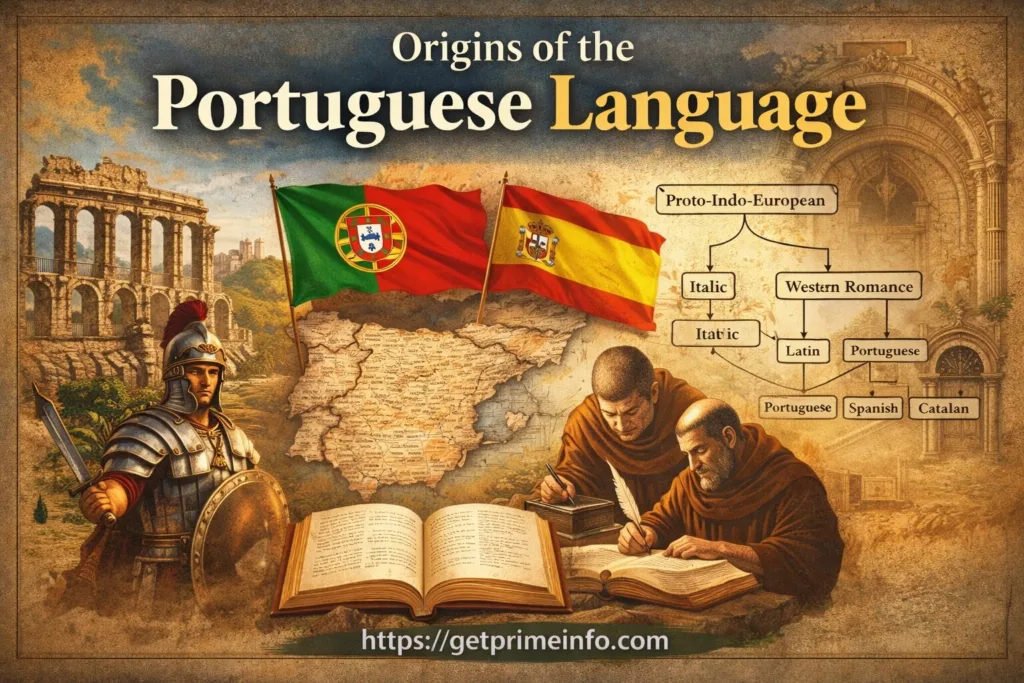
To understand Portuguese, we need to travel back over 2,000 years. Picture the Iberian Peninsula — the land we now call Portugal and Spain. Before Portuguese existed, this region was a patchwork of tribes speaking Celtic and Iberian languages, each with its own identity and linguistic traditions. Communication varied from valley to valley, and no single language unified the territory. Then came the Romans in 218 BCE, and everything changed. Through conquest, infrastructure, and administration, they gradually unified the region under Roman control, reshaping not only politics and society but also language.
The Romans didn’t just conquer land; they brought their language — Latin. However, it wasn’t the refined Classical Latin found in literature or official speeches. Instead, they spread Vulgar Latin, the everyday spoken form used by soldiers, traders, and settlers. This practical version of Latin evolved naturally over time, adapting to local pronunciation patterns and absorbing elements from existing Iberian tongues. Many linguistic transformations occurred dado à constant interaction between Roman settlers and indigenous populations, as well as regional isolation within the peninsula. Vulgar Latin is therefore the true ancestor of Portuguese, Spanish, French, Italian, and Romanian, and its gradual transformation in Iberia laid the essential groundwork for what would eventually become the Portuguese language.
Over time, Latin mixed with local languages. Words shifted. Pronunciations softened. Grammar simplified. After the fall of the Roman Empire in the 5th century, the Iberian Peninsula was invaded by Germanic tribes like the Visigoths. Later, in 711 CE, the Moors from North Africa conquered much of the region. Each wave left linguistic footprints.
Arabic, in particular, influenced Portuguese heavily. Words like “azeite” (olive oil), “almofada” (pillow), and “arroz” (rice) trace back to Arabic origins. In fact, thousands of Portuguese words beginning with “al-” come directly from Arabic.
By the 9th century, a distinct form of speech known as Galician-Portuguese began to emerge in the northwest of the Iberian Peninsula. This wasn’t yet “Portuguese” as we know it. Instead, it was a shared language spoken in what is now northern Portugal and Galicia in Spain.
Think of it as a linguistic sibling relationship. Portuguese and Galician were once the same language. But political borders and national identity eventually pulled them apart.
Languages evolve slowly, almost invisibly. No one wakes up one morning speaking a new language. Instead, generations shape it bit by bit. Portuguese is the result of centuries of blending, adapting, and refining. It’s a linguistic mosaic built from Latin foundations, Arabic influence, and local innovation.
And this was only the beginning.
The Role of the Roman Empire in Shaping Portuguese
If Portuguese had a birthplace, it would be Roman Iberia. The Roman Empire didn’t just introduce Latin — it reshaped the entire cultural and social structure of the region. Roads were built. Cities were established. Trade expanded. And everywhere the Romans went, their language followed.
But here’s the key detail: the Latin spoken in Iberia wasn’t uniform. Soldiers, merchants, farmers — they all spoke slightly differently. Over time, regional variations developed. The Latin in Iberia began to sound different from the Latin in Gaul (modern France) or Italy.
After the Roman Empire collapsed in the 5th century, communication between regions decreased. Without a centralized authority enforcing standard Latin, local dialects drifted further apart. That’s when Vulgar Latin truly began transforming into early Romance languages.
In the northwest of Iberia, this transformation produced Galician-Portuguese. The geography of the region helped preserve its uniqueness. Mountains and rivers acted like natural barriers, limiting outside influence and allowing the dialect to evolve in its own direction.
One fascinating aspect of Portuguese that reflects its Latin roots is its verb system. Portuguese retains complex verb conjugations that closely resemble Latin structures. While English relies heavily on word order, Portuguese uses verb endings to show tense, mood, and subject.
For example:
| Latin | Portuguese | English |
| amare | amar | to love |
| amo | amo | I love |
| amavi | amei | I loved |
You can almost see the transformation happening step by step.
Even pronunciation carries Latin echoes. Portuguese nasal vowels, though developed later, still reflect phonetic shifts from Latin endings. It’s like hearing ancient Rome whispering through modern speech.
Without the Roman Empire, the Portuguese simply wouldn’t exist. The Romans planted the seed. History, migration, and culture helped it grow into something entirely its own.
But the real turning point? That came when Portugal became a nation.
Medieval Portuguese and the Birth of a Nation
History and language are like twins — when one changes, the other follows. And nowhere is that clearer than in medieval Portugal. By the 12th century, political tensions in the Iberian Peninsula were reshaping borders. In 1139, Afonso Henriques declared Portugal an independent kingdom. That moment didn’t just create a country — it gave Portuguese the space it needed to grow into its own identity.
Before independence, the language spoken in northern Portugal and Galicia was known as Galician-Portuguese. It wasn’t just everyday speech; it was also the language of poetry. In fact, medieval lyrical poetry known as cantigas flourished between the 12th and 14th centuries. These poetic songs, often about love, friendship, or satire, are some of the earliest written records of the language. Imagine troubadours singing emotional verses in castle courtyards — that’s how Portuguese literature was born.
But as Portugal solidified its independence, linguistic separation began. Political boundaries influenced cultural identity. Galicia remained under the Kingdom of León and later Castile (Spain), while Portugal developed separately. Over time, the shared language split. Galician absorbed stronger Spanish influences, while Portuguese evolved under its own national institutions.
In 1290, King Dinis made a landmark decision: he declared Portuguese the official language of administration and law, replacing Latin. This was revolutionary. Latin had dominated official documents for centuries. By elevating Portuguese to official status, the king effectively validated it as a language of power, governance, and scholarship.
This period also marked important grammatical stabilization. Spelling began to standardize, and vocabulary expanded. Written Portuguese started resembling what we recognize today. Of course, it wasn’t identical — spelling was inconsistent, and pronunciation varied — but the foundation was there.
What’s fascinating is how quickly language becomes a symbol of identity. For medieval Portugal, speaking Portuguese wasn’t just practical; it was patriotic. Language became the thread tying together farmers, nobles, merchants, and sailors.
And those sailors? They would soon carry Portuguese far beyond Europe.
Portuguese During the Age of Exploration
If medieval Portugal shaped the language’s identity, the Age of Exploration turned it into a global force. Beginning in the 15th century, Portuguese explorers set sail into unknown waters. Names like Vasco da Gama and Ferdinand Magellan became legendary. But alongside gold, spices, and trade routes, they carried something less visible — their language.
Portugal’s strategic location on the Atlantic coast made it a maritime powerhouse. As explorers navigated around Africa, reached India, and eventually arrived in Brazil in 1500, Portuguese became the language of trade, diplomacy, and colonization.
Think about this: during the 16th century, Portuguese was one of the world’s primary international trade languages. From the coasts of Africa to ports in India and Southeast Asia, merchants communicated in Portuguese. In many Asian trading centers, knowing Portuguese meant access to business opportunities.
But languages don’t travel unchanged. As Portuguese spread, it absorbed local influences. In Africa, it mixed with Bantu languages. In Asia, it interacted with Malay, Tamil, and Chinese dialects. In Brazil, it blended with Indigenous Tupi languages and later African languages brought by enslaved populations.
This linguistic mixing led to the creation of Portuguese-based creole languages in places like Cape Verde, Guinea-Bissau, and Macau. These creoles developed simplified grammar but retained Portuguese vocabulary at their core.
Meanwhile, back in Portugal, the language continued to evolve. The Renaissance brought an explosion of literature. Luís de Camões, Portugal’s most famous poet, wrote Os Lusíadas in 1572 — an epic poem celebrating Portuguese exploration. This work elevated Portuguese literature to international recognition.
The Age of Exploration transformed Portuguese from a regional European language into a global one. It crossed oceans, adapted to new climates, and took on new accents. Few languages can claim such an expansive maritime journey.
And yet, its most significant transformation happened in South America.
Global Expansion: Portuguese in Africa, Asia, and the Americas
Brazil’s Linguistic Evolution
When Pedro Álvares Cabral arrived in Brazil in 1500, he likely had no idea that the land would become the heart of the Portuguese-speaking world. Today, Brazil accounts for roughly 80% of all Portuguese speakers globally. That’s enormous.
At first, Portuguese settlers were vastly outnumbered by Indigenous populations speaking Tupi and other native languages. For centuries, a language called Língua Geral — based on Tupi — was widely spoken. It wasn’t until the 18th century that Portuguese became dominant, largely due to government policies enforcing its use.
Brazilian Portuguese developed differently from European Portuguese. Geographic distance and social diversity shaped pronunciation, vocabulary, and rhythm. Brazilian Portuguese sounds more open and melodic, with clearer vowel pronunciation compared to the often reduced vowels in European speech.
African languages also influenced Brazilian Portuguese significantly. Words related to food, music, and religion — like samba, quilombo, and candomblé — have African origins. Brazilian Portuguese is, in many ways, a linguistic tapestry woven from Indigenous, African, and European threads.
African Varieties of Portuguese
Portuguese is an official language in Angola, Mozambique, Guinea-Bissau, Cape Verde, and São Tomé and Príncipe. In many of these countries, it serves as a unifying language among diverse ethnic groups.
Interestingly, African Portuguese varieties often preserve clearer pronunciation patterns compared to European Portuguese. At the same time, local languages influence vocabulary and expressions. The result? Distinct national flavors of Portuguese that reflect African cultural identity.
Asian Influences and Creoles
In Asia, Portuguese established early trade routes in India (Goa), Sri Lanka, Malaysia (Malacca), and China (Macau). Although Portuguese isn’t widely spoken there today, its legacy remains visible in loanwords and creole languages.
For example, in parts of India and Sri Lanka, Portuguese-based creoles still survive in small communities. Even Japanese has borrowed words from Portuguese, such as pan (bread), derived from pão.
It’s remarkable how far a language can travel. From Roman soldiers in Iberia to traders in Southeast Asia, Portuguese has crossed both geography and culture with surprising adaptability.
Modern Portuguese Language
Today, Portuguese exists in multiple standardized forms. The two most prominent are European Portuguese and Brazilian Portuguese. Though mutually intelligible, they differ in pronunciation, vocabulary, and even grammar usage.
European Portuguese tends to reduce unstressed vowels, making speech sound faster and sometimes harder for learners to understand. Brazilian Portuguese pronounces vowels more clearly and often uses subject pronouns more explicitly.
For example:
- European Portuguese: Estou a falar.
- Brazilian Portuguese: Estou falando.
- English: “I am speaking.”
Both are correct — just different styles of expression.
Efforts like the Orthographic Agreement of 1990 attempted to unify spelling across Portuguese-speaking countries. While not universally accepted, it reduced some differences in written form.
Despite regional variations, Portuguese remains a cohesive global language. Media, music, film, and digital communication help bridge differences between continents.
Portuguese today is dynamic, expanding, and digitally present. It thrives on social media, in global business, and in international organizations like the Community of Portuguese Language Countries (CPLP).
From its humble beginnings in Roman Iberia to its status as a world language, Portuguese has evolved through conquest, poetry, trade, and migration. It carries history in every syllable.
Phonetics and Pronunciation Guide
Portuguese pronunciation can feel like stepping into a musical performance. It’s rhythmic, fluid, and sometimes surprisingly subtle. At first glance, you might think it resembles Spanish. And yes, they share similarities. But once you listen closely, you realize Portuguese has its own distinct soundscape — softer, often more nasal, and packed with unique vowel combinations that give it that signature melody.
One of the most striking features of Portuguese is its nasal vowels. Unlike English, where nasal sounds are usually followed by “n” or “m,” Portuguese often nasalizes the vowel itself. Words like pão (bread), mãe (mother), and não (no) carry that nasal resonance. It’s as if the sound lingers in the air for a moment longer. This nasal quality developed from Latin vowel shifts and later phonetic evolution, especially during the medieval period.
Portuguese has:
- 9 oral vowels
- 5 nasal vowels
- Multiple diphthongs (two vowel sounds combined)
This makes vowel pronunciation extremely important. A slight shift can change meaning. For example:
- avô (grandfather)
- avó (grandmother)
One tiny accent mark, completely different meaning.
Consonants also have unique traits. The letter “lh” in filho (son) sounds similar to the “lli” in “million.” The “nh” in vinho (wine) resembles the “ny” in “canyon.” These combinations trace back to Latin consonant clusters that softened over time.
European and Brazilian pronunciation differ significantly. European Portuguese tends to “swallow” unstressed vowels. Brazilian Portuguese pronounces them more openly. For learners, Brazilian Portuguese often feels clearer and easier to understand initially.
Stress patterns matter, too. Portuguese words typically stress the second-to-last syllable unless marked otherwise. Accent marks aren’t decorative — they guide pronunciation and stress.
Mastering pronunciation is like tuning an instrument. At first, it feels awkward. But once you grasp the rhythm, the language flows naturally. And when it flows, it’s beautiful.
Portuguese Grammar Essentials
If pronunciation is the melody of Portuguese, grammar is its structure — the framework that keeps everything in place. Portuguese grammar may seem complex at first glance, especially if you’re coming from English. But once you understand the logic behind it, patterns begin to reveal themselves.
Sentence Structure
Portuguese generally follows a Subject-Verb-Object (SVO) structure, similar to English:
- Eu amo você. (I love you.)
- Ela estuda português. (She studies Portuguese.)
However, Portuguese allows flexibility. Subject pronouns are often dropped because verb conjugations already indicate the subject. For example:
- Falo português. (I speak Portuguese.)
The verb ending “-o” already tells us it’s “I,” so eu isn’t necessary.
Verb Conjugation System
Verbs are the backbone of Portuguese, and yes — they conjugate extensively. There are three main verb endings in their infinitive forms:
- -ar (falar – to speak)
- -er (comer – to eat)
- -ir (abrir – to open)
Each tense changes the ending based on person and number. For example, falar in present tense:
- Eu falo
- Tu falas
- Ele/Ela fala
- Nós falamos
- Vocês falam
- Eles falam
Portuguese verbs also include multiple past tenses (preterite and imperfect), future tense, conditional, and subjunctive moods. The subjunctive, in particular, expresses doubt, emotion, or uncertainty — something English often handles with auxiliary verbs.
Yes, it’s detailed. But it’s also logical. Once patterns click, conjugation becomes predictable.
Gender and Articles
Like other Romance languages, Portuguese nouns have gender — masculine or feminine.
- O livro (the book – masculine)
- A casa (the house – feminine)
Articles change accordingly:
- Singular: o / a
- Plural: os / as
Adjectives must agree with the noun’s gender and number:
- Menino bonito (handsome boy)
- Menina bonita (beautiful girl)
Grammar in Portuguese may feel like assembling a puzzle. Each piece must fit correctly. But once assembled, the picture is clear and expressive.
Vocabulary and Word Formation
Portuguese vocabulary is a fascinating blend of historical layers. At its core lies Latin. In fact, the majority of Portuguese words trace directly back to Latin roots. If you speak Spanish, French, or Italian, you’ll recognize many similarities.
But Portuguese didn’t stop at Latin. History kept adding ingredients to the linguistic recipe.
Arabic Influence
During Moorish rule (711–1249), Arabic left a deep imprint. Thousands of words entered Portuguese, particularly in agriculture, science, and architecture.
Examples include:
- Açúcar (sugar)
- Alface (lettuce)
- Algodão (cotton)
- Almofada (pillow)
Notice the “al-” prefix? That’s a clear Arabic fingerprint.
Indigenous and African Contributions
In Brazil, Indigenous Tupi languages introduced words related to nature and wildlife:
- Abacaxi (pineapple)
- Jaguar
- Tatu (armadillo)
African languages contributed vocabulary linked to culture, food, and religion:
- Samba
- Quilombo
- Dendê (palm oil)
These aren’t minor influences — they shape the cultural identity embedded in the language.
Modern Borrowings
Like English, Portuguese absorbs foreign words, especially from English in technology and business:
- Internet
- Marketing
- Download
Sometimes they adapt spelling; sometimes they don’t. Language is alive — it borrows, reshapes, and evolves constantly.
Portuguese vocabulary reflects centuries of interaction. It’s a linguistic museum where each word carries a story.
Portuguese Dialects Around the World
Portuguese isn’t monolithic. It’s a global language with regional personalities.
Regional Variations in Portugal
Northern Portuguese sounds different from Lisbon speech. The north tends to preserve older pronunciation patterns, while Lisbon speech has influenced the national standard.
Island regions like Madeira and the Azores have distinct accents influenced by historical settlement patterns.
Brazilian Dialects
Brazil’s size guarantees diversity. Speech in Rio de Janeiro differs from São Paulo, which differs from Bahia or the southern states.
For instance:
- In Rio, the “s” at the end of syllables often sounds like “sh.”
- In São Paulo, pronunciation is flatter and more direct.
- In the Northeast, speech can be slower and more melodic.
Despite differences, mutual understanding remains strong.
African and Asian Variants
African Portuguese varieties incorporate local vocabulary and speech rhythms. In Angola and Mozambique, Portuguese coexists with dozens of local languages, influencing pronunciation and expression.
Macau preserves a historical form influenced by Cantonese. Cape Verde maintains a Portuguese-based creole spoken widely alongside standard Portuguese.
Think of Portuguese as a tree with many branches. The trunk remains solid, but each branch grows in its own direction.
Cultural Influence of the Portuguese Language
Language shapes culture — and Portuguese culture is deeply intertwined with its words.
Literature and Poetry
From medieval cantigas to modern novels, Portuguese literature has global significance. Luís de Camões, Fernando Pessoa, and José Saramago (a Nobel Prize winner) have shaped world literature.
Brazilian authors like Machado de Assis and Clarice Lispector bring psychological depth and innovation to Portuguese literature.
Music and Media
Fado music in Portugal expresses longing — a feeling known as saudade, a uniquely Portuguese word that captures deep emotional nostalgia.
In Brazil, genres like samba and bossa nova showcase the rhythm and fluidity of the language.
Portuguese isn’t just spoken — it’s sung, recited, performed.
Why Learn Portuguese Today?
Why invest time in Portuguese? Because it opens doors.
- Brazil is one of the largest economiesin the world.
- Portuguese-speaking Africa is rapidly developing.
- Portugal offers access to European markets.
- It connects you to over 260 million people worldwide.
Beyond economics, there’s cultural richness. Imagine understanding Brazilian films without subtitles. Or reading poetry in its original language. Or traveling across Lisbon and feeling truly connected.
Portuguese is both practical and poetic — a rare combination.
Practical Guide to Learning Portuguese
Learning Portuguese requires strategy.
Tips for Beginners
- Master pronunciation early.
- Focus on verb conjugations daily.
- Listen to music and podcasts.
- Practice speaking immediately.
- Learn common phrases before advanced grammar.
Common Beginner Mistakes
- Ignoring gender agreements.
- Mispronouncing nasal vowels.
- Translating directly from English.
- Confusing Brazilian and European usage.
Consistency matters more than perfection. Language learning is like building muscle — repetition creates strength.
Portuguese in the Digital Age
Portuguese thrives online. Brazil ranks among the largest internet user populations globally. Social media, YouTube, podcasts, and streaming platforms produce massive amounts of Portuguese content daily.
Portuguese is also one of the top languages used on Wikipedia and major digital platforms. Its global presence continues expanding through business, entertainment, and education.
The language that once traveled by ship now travels by fiber-optic cable.
Conclusion
Portuguese began as Vulgar Latin spoken on the edges of the Roman Empire. It survived invasions, evolved through medieval poetry, expanded through maritime exploration, and transformed into a global language spoken across four continents.
It carries Latin structure, Arabic vocabulary, African rhythm, Indigenous expression, and modern innovation. It is at once ancient and contemporary, regional and global.
Whether you’re learning it for business, travel, culture, or curiosity, Portuguese offers more than communication — it offers connection. Each word carries centuries of history. Each accent reflects geography. Each expression reveals identity.
And that’s the magic of Portuguese. It’s not just spoken. It’s lived.
FAQs
1. How many countries speak Portuguese as an official language?
Portuguese is the official language of nine countries, including Portugal, Brazil, Angola, Mozambique, and Cape Verde.
2. Is Brazilian Portuguese different from European Portuguese?
Yes. They differ in pronunciation, vocabulary, and some grammar usage, but they remain mutually intelligible.
3. How difficult is Portuguese for English speakers?
Portuguese is considered moderately difficult due to verb conjugations and pronunciation, but similarities with other Romance languages can help.
4. What makes Portuguese unique compared to Spanish?
Portuguese features nasal vowels, distinct pronunciation patterns, and unique vocabulary influenced heavily by Arabic and Indigenous languages.
5. Why is Portuguese important globally?
It connects over 260 million speakers across four continents and plays a significant role in global trade, culture, and diplomacy.