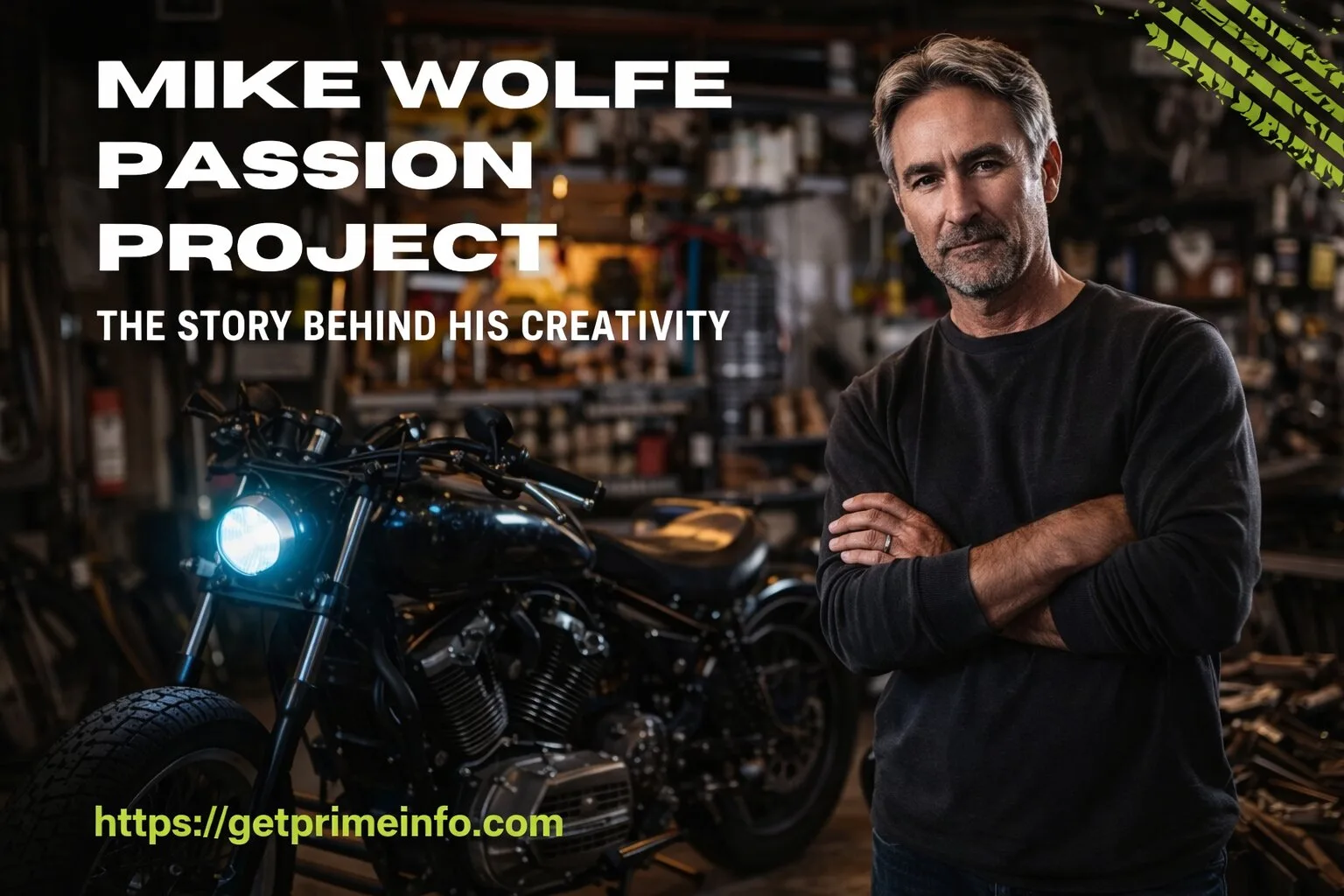
Mike Wolfe Passion Project: The Story Behind His Creativity
There’s a moment Mike Wolfe has described many times — standing inside a crumbling barn, holding an object that nobody has touched in 50 years, feeling the weight of the story it carries. Most people would see rust and dust. Wolfe sees a life, a craft, a community, a chapter of American history that is one generation away from being erased forever.
That feeling is the engine behind everything he does. And it goes far deeper than what you’ve seen on television.
Most people know Mike Wolfe as the affable, fast-talking host of American Pickers on the History Channel. But the show — as beloved as it is — is really just the surface. Underneath it is a man with a genuine, lifelong obsession with rescuing what America leaves behind. His passion project isn’t a marketing initiative or a celebrity side hustle. It’s the reason he got into this work in the first place, and it’s the most important thing he’s building.
This is the full story.
Table of Contents
Who Is Mike Wolfe? The Roots of an Obsession
Mike Wolfe was born on June 11, 1964, in Joliet, Illinois, and raised in Bettendorf, Iowa — a small Midwestern town that shaped everything about how he sees the world. From the time he could ride a bike, he was pedaling miles to flea markets, junkyards, and estate sales, drawn by an instinct he couldn’t fully explain.
He wasn’t just looking for stuff. He was looking for stories.
The objects that stopped him weren’t always the most valuable or the most visually striking. They were the ones that carried the unmistakable fingerprints of real life — tools worn smooth by decades of use, signs faded by years of sun, photographs tucked inside drawers and forgotten. These things spoke to him.
That childhood sensitivity — the ability to feel the human story inside an object — became the foundation of his entire career. When American Pickers launched in January 2010, it gave that instinct a national audience. But the passion project it feeds into is something much larger, more personal, and more enduring than any television series.
What Is the Mike Wolfe Passion Project, Really?
The Mike Wolfe Passion Project is not one single thing. It’s a philosophy made physical — expressed through restorations, community investments, storytelling, and advocacy.
At its core, it’s built on one powerful idea: the objects and buildings that ordinary Americans leave behind are not trash. They are primary sources. They are evidence that real people lived, worked, built, struggled, and created here.
When those objects are thrown out and those buildings are demolished, we don’t just lose wood and metal. We lose the texture of a lived experience that no history book will ever fully capture.
Wolfe has spent decades — and millions of dollars — fighting against that erasure. His tools are restoration, reinvention, and storytelling. His stage is small-town America.
Columbia, Tennessee: Where the Vision Became a Movement
If you want to understand the Mike Wolfe Passion Project in the most concrete terms possible, go to Columbia, Tennessee. What Wolfe has done there is extraordinary.
Columbia Motor Alley
In November 2017, Wolfe purchased a 13,440-square-foot historic Chevrolet dealership built in 1947 for $400,000. He didn’t flip it. He didn’t convert it into condominiums. He restored it — turning it into a living, working space that honors its automotive heritage while serving a new generation of visitors.
Columbia Motor Alley now houses a full-service repair shop, a curated display of Wolfe’s personal car and motorcycle collection, and a merchandise store. It’s part museum, part workshop, part community gathering spot. The building remembers what it was. And because of Wolfe, so can everyone who visits.
The Historic Italianate House
Wolfe purchased a 151-year-old Italianate house in Columbia for $700,000. The structure had lost its original tower and cupola over the decades — details that completely define its architectural character. Rather than accepting that loss, Wolfe tracked down historical photographs of the building in its original condition and used them as a blueprint to restore what had been removed.
That level of commitment — spending money and time to recover accuracy rather than just functional habitability — tells you everything about his intentions.
The Esso Gas Station Revival
In May 2025, Wolfe unveiled the transformation of a historic Esso gas station in downtown Columbia into a vibrant community space. He shared the project on social media to an enormous response — fans and locals alike flooded the comments with admiration and gratitude.
His goal for the space was explicit: to create something that generations of people can enjoy for years to come. Not a quick win. A lasting contribution.
Revival Wine Bar
Wolfe purchased another Columbia property in September 2022 for $600,000, investing in an outdoor pergola, fire pit, stage, and custom shelving. After navigating inspections and renovation challenges, it opened by mid-2025 as Revival — a wine bar and community venue that gives residents a beautiful, character-rich place to gather.
Each of these projects follows the same pattern: find the historic soul of a space, honor it faithfully, and then give it a new purpose that brings people together.
Antique Archaeology: Where Stories Live
Wolfe’s Antique Archaeology stores in LeClaire, Iowa, and Nashville, Tennessee, are more than retail operations. They are physical embodiments of his philosophy.
Every item in those stores carries documentation of its story — where it came from, who used it, what era it represents. The experience of shopping there isn’t browsing merchandise. It’s walking through a curated fragment of American life.
Both locations have become genuine tourist destinations, drawing visitors who then spend money at nearby restaurants, hotels, and shops. In LeClaire, especially, Antique Archaeology has become an economic anchor for the broader community — proving that cultural preservation and economic development are not competing goals. They are the same goal.
The “Nashville’s Big Back Yard” Initiative
One of Wolfe’s most ambitious projects isn’t a single building — it’s an entire regional identity.
He’s a leading voice in “Nashville’s Big Back Yard,” a collaborative initiative connecting more than a dozen small towns along a 100-mile stretch of the Natchez Trace Parkway. The project is designed to promote heritage tourism across the region, encouraging visitors to explore the authentic, small-town character of communities that mainstream tourism overlooks.
It’s a brilliant model. Rather than competing, these towns unite around a shared identity rooted in real history. The result is a regional brand that no marketing campaign could manufacture — because it’s entirely genuine.
The Numbers Behind the Impact
It’s worth pausing on what heritage preservation actually does for communities economically, because the numbers are striking.
The global heritage tourism market was valued at $604.38 billion in 2024 and is projected to grow at 4.5 percent annually through 2030. Heritage tourists — the kind that Wolfe’s projects attract — typically spend more per visit and stay longer than standard tourists.
In Columbia, empty storefronts became active businesses. Property values improved. Visitors began arriving specifically because of what Wolfe had built there. Search interest in “Mike Wolfe Passion Project” rose 280 percent in recent months, and related Pinterest boards grew 400 percent — signs of a rapidly expanding audience that cares deeply about this work.
Those aren’t vanity metrics. They represent real curiosity, real tourism intent, and real economic potential for the communities where Wolfe invests.
The Philosophy: Collecting Stories, Not Objects
Perhaps the most important thing to understand about the Mike Wolfe Passion Project is what it’s actually not about.
It’s not about accumulation. It’s not about flipping properties for profit. It’s not about nostalgia for its own sake.
It’s about the conviction that stories matter — that the physical remnants of how people lived, worked, and built community are worth protecting not as relics but as living connections between past and present.
Wolfe has said that he doesn’t think of himself as a collector of objects. He thinks of himself as a keeper of stories. The object is just the vessel. The story is what he’s preserving.
That distinction reshapes how you see everything he does. The restored gas station isn’t just a nice building. It’s a story about a particular moment in American commercial life, a particular community, a particular era of the road trip and the open highway. When people walk into that space, they don’t just see a renovation. They feel something.
That feeling — that sense of connection to something real and human — is what Wolfe is in the business of creating.
How You Can Be Part of This Movement
The Mike Wolfe Passion Project is explicitly an open invitation. Wolfe has consistently used his platform to encourage others to engage with their own local history — not just to watch him do it, but to do it themselves.
Here’s what that looks like practically:
Visit and support. Antique Archaeology in LeClaire, Iowa, and Nashville, Tennessee, is both worth the trip. The communities around them benefit from every visitor. The towns along the Natchez Trace Parkway are equally worth exploring.
Document before it disappears. You don’t need millions of dollars to participate in preservation. You need a phone camera and the habit of paying attention. Photograph old buildings, record stories from elders in your community, and catalog family artifacts before they’re lost.
Advocate locally. Historic preservation boards, community development organizations, and local historical societies all need engaged citizens. The most impactful preservation often happens not on television but in a planning meeting when someone argues that a building deserves to stay.
Share the story. Wolfe’s work spreads because people talk about it. Every conversation you start about local history, every social media post about a neighborhood that deserves attention, every recommendation to visit a small town with real character — these are acts of preservation too.
Final Thoughts: Why This Work Matters Now More Than Ever
There’s an urgency to what Mike Wolfe is doing that he rarely states directly but that runs beneath every project. We are living through a period of rapid change, and as communities transform, the physical evidence of how they came to be is disappearing faster than ever.
Old gas stations get torn down for strip malls. Historic buildings get gutted for generic apartment conversions. Objects that were ordinary in 1952 become irreplaceable in 2025 — but only if someone saved them.
Wolfe has devoted his career, his resources, and his public platform to being that someone. Not because someone told him to. Not because it’s profitable. Because he genuinely believes that without these stories, we understand ourselves less fully.
Every barn he walks into, every building he restores, every rusted object he holds up to the light and says “this matters” — it’s an argument. An argument that the ordinary lives of ordinary Americans deserve to be remembered. The texture of daily life across generations is worth protecting. That history isn’t only what happened in government buildings and on battlefields. It’s also what happened in a roadside diner in Tennessee, in a gas station in Iowa, in a barn in rural Ohio, where someone’s grandfather kept something beautiful long after the world stopped caring about it.
That argument is the passion project. And the more people who join it, the better chance we have of winning.
What’s the piece of history in your own community that deserves someone like Mike Wolfe to notice it — and are you willing to be that person?